

Three Days, Eleven Projects, One Goal
How the Axoflow team moved fast with AI by knowing where to draw the line.,
Most of our engineering time belongs to customers. The features SOC teams ask for, the exotic new sources a deployment needs, the migration that has to land before a renewal. That is how it should be. A good security platform earns its place by solving the problems people bring to it.
But the best ideas do not always arrive as tickets. Our engineers hear customers on calls, in PoCs and in support threads, and they know which requests keep coming back. I want teams that act on that without waiting to be told. Self-driven teams are a big part of why we move as fast as we do.
So in October we gave the whole team three days and unlimited AI tokens to build what they keep hearing customers ask for, or their own vision of where the product should go. On October 21, eleven projects were demoed. I watched every one of them, and I was blown away with what I saw. Here is the first batch: four projects that are on their way into the product, along with the principle that ran through almost all of them.
Lean into AI where people work
The market is right about one thing: AI changes how people use security tools. Writing a query, building a dashboard, understanding why a chart looks the way it does - these should feel like a conversation, not a manual effort.
Our 11 teams leaned in without hesitation. They used AI to build faster, and they put it inside the product. That is exactly the instinct I want to be present in this team.
Keep deterministic what has to be deterministic
Here is where we part ways with much of the market. AI belongs where a person can see the result and judge it. It does not belong in the parts that must give the same answer every time.
Classification, parsing and normalization are those parts. Axoflow classifies hundreds of log formats with heuristic, rule-based matching. We use AI to help us write and maintain those rules, but the rules themselves run the same way every time: a format either matches or it does not. When your detections depend on a field being exactly where it should be, "probably" is not good enough.
AI helps you work with the data. It does not get to decide what the data is.
Search View: seeing what your logs are actually doing
You would think that designing a search or query interface is a solved problem in the industry. It is still evolving. Benedek Mihalik and Daniel Lazar took a fresh look at it from a UX perspective. Even with AI agents, engineers will still need a way to validate and correlate information based on their knowledge and experience, which means browsing telemetry through an interface. Seemingly minor changes help you understand your telemetry better. Was there a gap where logs went missing? Where exactly am I in the timeline during an investigation? How can I approach the investigation from different angles?
For a security team, that is not a cosmetic issue. A source that goes quiet is exactly what you need to notice.
In three days they rebuilt it: a real time axis, a trend indicator against the previous period, selection by dragging on the chart itself, grouping by product or host, and a heatmap view that shows at a glance which source went quiet.
What I liked most was how they presented it by pinpointing small but important details. They made clear exactly which parts were solid and which parts were owned by AI, and how they filled the backend gaps with AI instead of waiting for another team. That is the right relationship with AI: use it to go fast, and keep checking its work.
Canvas: dashboards built around your team
I see real value in purpose-built dashboards that help engineers make sense of the mess. This is what people use AI for now, but you need to ask the right questions to make it work. Freedom has its advantages, but I value “good defaults” that you can customize and build on. The Canvas project is the best of both worlds, providing building blocks built on the vast experience of our engineers, while giving you the freedom to customize and organize them to your preference, using AI instead of manual fiddling. This is the fine line between throwing AI at a problem and solving a problem with the help of AI.
Canvas lets users build their own boards from a library of widgets on a free-form grid. Ask the assistant for "a DevOps board" and it proposes a plan, then builds it. When no widget fits, a designer chat writes a new one.
Same principle again. The AI builds the view. The numbers and formulas behind it come from the same deterministic pipeline as everything else, so the data you see is always correct.
KQL: the query language your analysts already know
Query languages are both the best friend and the worst enemy of analysts. They help us crunch through immense amounts of data and shape it the way we need. But there are many of them. Which one should you learn? AI can help with natural language queries. But natural language is not as deterministic as a query language. Your data can come in different schemas, and you may have context the AI does not. For example, a request to list all firewalls in a region can be translated into several different queries. Use location labels? Use a regex based on a hostname convention? Filter for a known subnet? The AI will make a decision, but you still need to validate that the query covers your requirements.
So we are back to query languages. Axoflow provides AQL, a simple query language for logs, but it is mostly for filtering based on labels and log content. If you need correlation or similar analysis, you need a more expressive language. We don’t want to make that choice for you when you may already know SPL, KQL or another query language.
Within three days, and with the help of AI, the same dataset became queryable with KQL. The team built a KQL editor, with syntax highlighting, autocompletion from the log schema, and a field that grows to several lines when a query gets long. KQL is widely adopted in the Microsoft ecosystem and modern data lake solutions, so it was a strong first candidate.
But the real value is the framework behind it, which can take on any query language. So now a natural language query can be translated into a structured query that you can read and verify. You get the flexibility and the verifiability. The AI drafts the search. The search itself does exactly what the query says.
Python detection: when code beats a query
Detection as code is still less widely adopted than its benefits would suggest. We chose Sigma as our first detection format because it is the most widely used. From the start, though, the plan was to support more than one way to run detections. Sigma is the best fit for simple, text-based matching, but sometimes a few lines of code are easier than a huge query or an abstract rule description. So the team built a detection engine that runs rules written in Python, inside a sandboxed interpreter with hard resource limits. You can run Sigma rules, Python rules, or both.
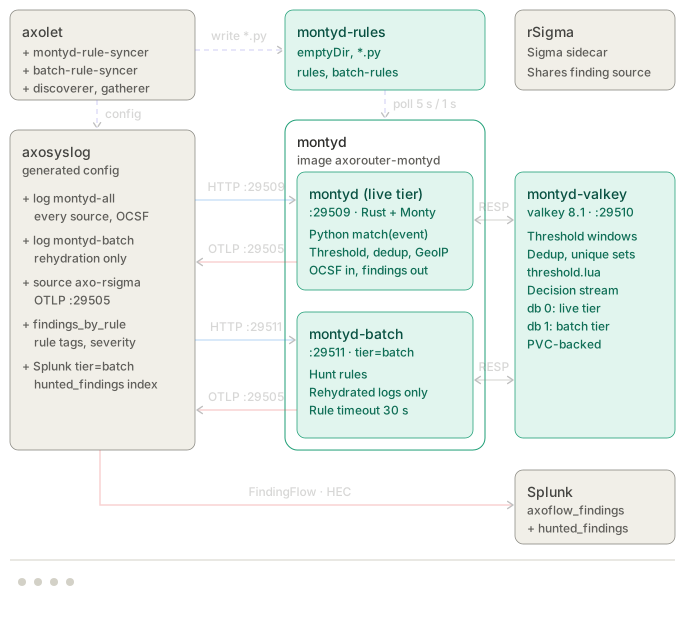
AI helped the team build the engine in three days, shortening every step from planning through the proof of concept to performance tuning. The engine even gives rules stateful storage at runtime, so a rule can keep track of what it has seen across events. What stunned me is that after three days this was not a rough proof of concept: the team had already polished the sandboxing and the performance. They reached more than 200,000 events per second on a single CPU with 50 rules enabled. Performance naturally depends on the complexity of the detections, but a typical setup of 200–300 rules at an estimated 30–40k EPS (already more than 2 TB/day) fits easily on a single CPU of the AxoRouter that processes the pipeline. Scaling vertically or horizontally multiplies those numbers.
Speed, focus, execution
Eleven projects in three days, and almost all of them were working demos, not slides. Some are closer to the product than others, and you will hear about several of them as they ship.
What stays with me is not a single feature. It is how quickly this team goes from idea to a working answer, and how consistently they start from what a user is actually struggling with. That is the muscle we use on customer projects every day. The reason these features are not already available in the product is the same quality bar we apply everywhere: only components that are pragmatic, deterministic where it matters, and quality assured make it in.
AI made us faster. Determinism keeps us right. We intend to keep both.

Follow Our Progress!
We are excited to be realizing our vision above with a full Axoflow product suite.
Sign Me UpFighting data Loss?

Book a free 30-min consultation with syslog-ng creator Balázs Scheidler